Our Story
The Story of a Nation, Told
Through Its Builders
Engineering Human Potential. Born from Saudi Arabia’s golden generation of engineers, we engineer environments that unlock human potential through the fusion of trusted legacy and precision, accelerating the Kingdom’s transformation into a global hub of innovation
To become Saudi Arabia’s human-centric, tech-based engineering consultancy. The unrivaled partner transforming Vision 2030’s complex challenges into human-centric realities.
Engineering the non-tangible impact that elevates human life, delivering human-centric and precision-engineered environments.
Our Values
Our Values Are Not Declarations.
They Are Engineering Requirements
HUMAN CENTRIC DESIGN
Empathy is not a philosophy. It is a structural requirement.
Every design decision at ecec begins with a human question: who uses this space, and what do they need to thrive in it? This is not a soft differentiator. It is built into our technical process at every stage — from the first concept sketch to the final supervision inspection. The building that functions well is the one designed around the person for whom it was built, before the first wall went up.
ENGINEERING MASTERY
We don’t use technology to work faster. We use it to think further ahead.
ecec’s methodology is not an add-on; it is foundational. Our workflow eliminates coordination errors before they become site problems and transforms complex project data into predictable delivery outcomes.
PROACTIVE PARTNERSHIP
We are doers. We anticipate. We act before you ask
Rooted in the Eastern value of trust and honor, our partnerships are built on a commitment to listen actively and move proactively, not reactively. We do not wait for a problem to surface in a meeting room. Our process is designed to find it and resolve it before it has a name.
NATIONAL COMMITMENT
Every project we deliver is a direct service to Vision 2030 and our nation.
We do not treat Vision 2030 as a business opportunity. We treat it as a personal responsibility, one that began long before the Vision was formalized and will outlast any single project. ecec does not measure its success in square meters delivered. It measures the quality of life those square meters produce
EMPOWERED GROWTH
Our people are our most precise instrument.
Empowered Growth is not an HR policy. It is an engineering philosophy. We invest in the technical depth and personal development of every ecec professional because we understand the direct relationship: the quality of what we deliver reflects the capability and confidence of the people who deliver it.
The People Behind the
Precision
ecec’s leadership team brings together decades of technical mastery, national-scale project experience, and a shared commitment to engineering environments that serve people first.

Hisam Siddiqui
Chief Commercial Officer (CCO)
Mahmoud Al Bakri
Chief Operating Officer
Ibrahim Al-Askar
People & Culture Director
Miguel Outeiro
Design Director
Mirza Laeeq Baig
Business Excellence Director
Majdi Abu. El Azayem
Finance Director
Mohamed Maghouri
PD Director
Eng. Moutaz Ahmed
Projects Director for Power and Infrastructure
Walid El Sayed
Design Deputy Director
Eng. Martin Mcfadden
Engineering Manager
Othman AlAkrab
Sr. Projects Manager
Hifza Shafi
Sr. Projects Manager
Mohamed Mostafa
Sr. Bids Manager
Nour Moussa
Sr. Branding & Marketing Manager
Nourhan Aimen
Sr. Contracts & Claims Manager
Ahmed Nasr
Operation Manager
Mohamed Anwar
Operation Manager
Majdoline Samir
Operations Manager
Assim Ijaz
Company Financial Control Manager
Meqren Alboqmi
HR Operation Manager
Turki Faisal
IT Manager
Waqas Butt
Business Excellence Manager
Rakan Alrokan
Business Development Manager
Noura Alhuzaim
Business Development Manager
Mohamed AlJohary
Admin Manager
Tarek Mohamed
Sr. Manager Cost department
Main Zeyadah
Architect Lead
Rami Murad
Mechanical Lead
Mustafa Ismail
Structure Lead
Chito Gamboa
Electrical Lead
ecec way
Every ecec engagement runs on the same system: five names, one standard. 45+ years of Saudi projects taught us that firms fail not on skill, but on process and communication. At ecec, process guarantees our commitments. The ecec Way is our operating culture, ensuring client loyalty.
Legacy
Project completion is not the end of our responsibility. It is the beginning of long-term performance.
In Practice
Every engagement concludes with structured handover, coordinated documentation, testing, commissioning, and final reporting. Design packages, supervision records, and project documentation are delivered to enable confident operation from Day One.
Why It Matters
A successful handover gives clients more than completed works. It provides the confidence that every system, document, and deliverable is ready to support long-term operation.
Every ecec engagement runs on the same system: five names, one standard. 45+ years of Saudi projects taught us that firms fail not on skill, but on process and communication. At ecec, process guarantees our commitments. The ecec Way is our operating culture, ensuring client loyalty.
Sentinel
Successful projects are protected long before risks become problems.
In Practice
ecec manages stakeholder coordination, authority approvals, and project risks through structured communication plans, live risk registers, and proactive engagement with clients, consultants, contractors, and regulatory authorities. Potential issues are identified early, escalated quickly, and resolved before they affect programme delivery.
Why It Matters
Proactive governance reduces delays, protects project objectives, and allows clients to make informed decisions before risks become contractual or financial issues.
Every ecec engagement runs on the same system: five names, one standard. 45+ years of Saudi projects taught us that firms fail not on skill, but on process and communication. At ecec, process guarantees our commitments. The ecec Way is our operating culture, ensuring client loyalty.
Mastery
Quality is not inspected into a project. It is engineered into every stage of delivery.
In Practice
ecec embeds quality control throughout the project lifecycle. Design deliverables undergo multidisciplinary reviews before submission, while construction supervision applies structured QA/QC procedures, inspections, and reporting. Across PMC Project, quality plans ensure accountability, consistency, and measurable performance.
Why It Matters
Clients gain confidence knowing that every drawing, inspection, and project report has passed through a disciplined quality process long before final delivery.
Every ecec engagement runs on the same system: five names, one standard. 45+ years of Saudi projects taught us that firms fail not on skill, but on process and communication. At ecec, process guarantees our commitments. The ecec Way is our operating culture, ensuring client loyalty.
Covenant
Every project begins with a single approved baseline that aligns scope, schedule, responsibilities, and deliverables before work begins.
In Practice
Every Project begins with a structured project baseline. Design Project are developed in Primavera, construction supervision follows Critical Path Method (CPM), and PMC commissions establish milestone plans aligned with the client’s priorities. Throughout delivery, the baseline remains a live management tool—not a document filed away after project kickoff.
Why It Matters
Projects stay on schedule when every stakeholder works from the same agreed plan. Continuous monitoring allows deviations to be identified early, reducing risk, protecting budgets, and keeping delivery aligned with client objectives.
Every ecec engagement runs on the same system: five names, one standard. 45+ years of Saudi projects taught us that firms fail not on skill, but on process and communication. At ecec, process guarantees our commitments. The ecec Way is our operating culture, ensuring client loyalty.
Reconnaissance
Every successful project begins with complete understanding before a single decision is made.
In Practice
ecec begins every Project with structured discovery, aligning project objectives, stakeholder expectations, regulatory requirements, and site conditions before design or execution starts. This establishes a shared understanding that guides every subsequent phase.
Why It Matters
Early alignment minimizes assumptions, strengthens decision-making, and creates a reliable foundation for predictable project delivery.
Our Distinctions & Honors
Certifications & Awards

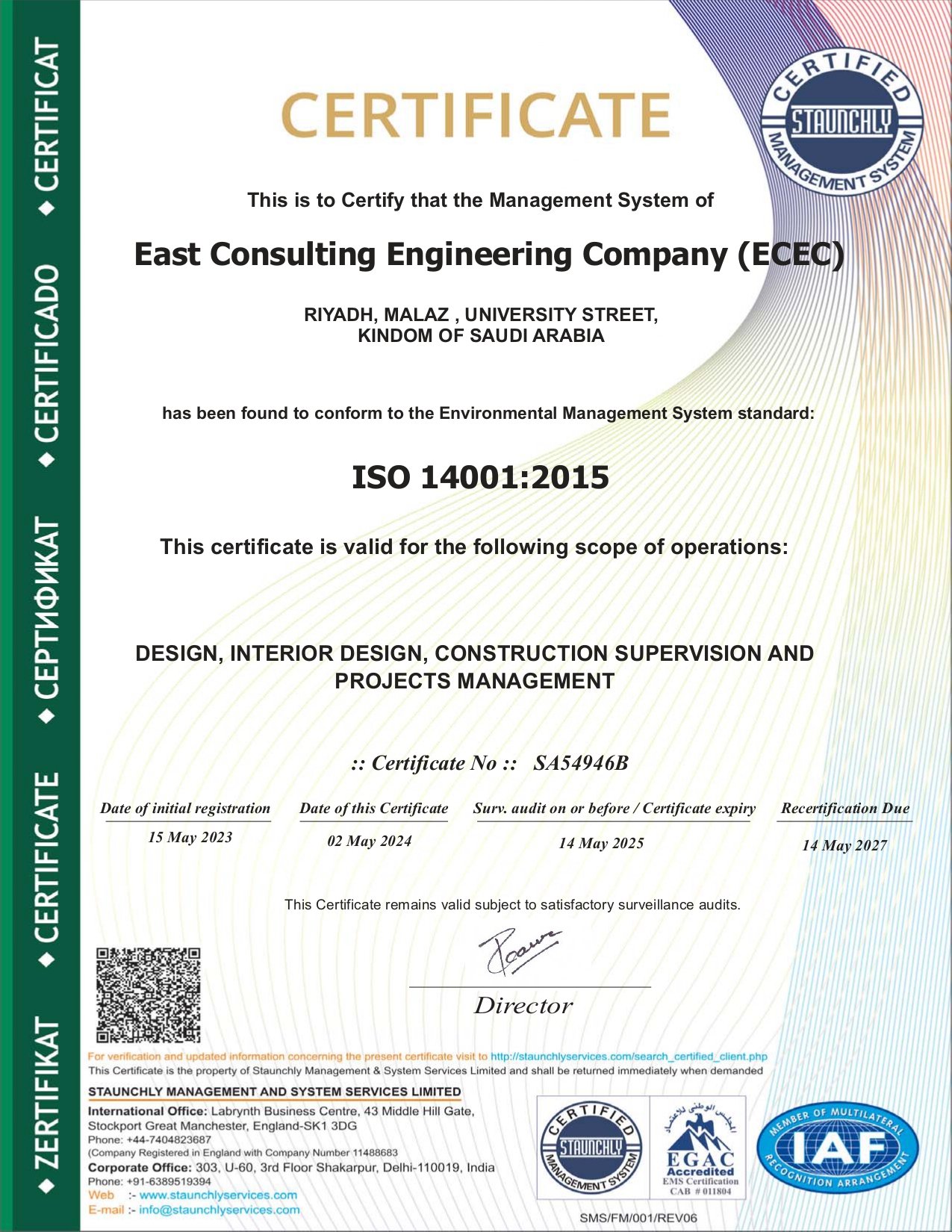
01. ISO 14001:2015
Quality Management Systems · International Organization for Standardization
Quality Management Systems · International Organization for Standardization
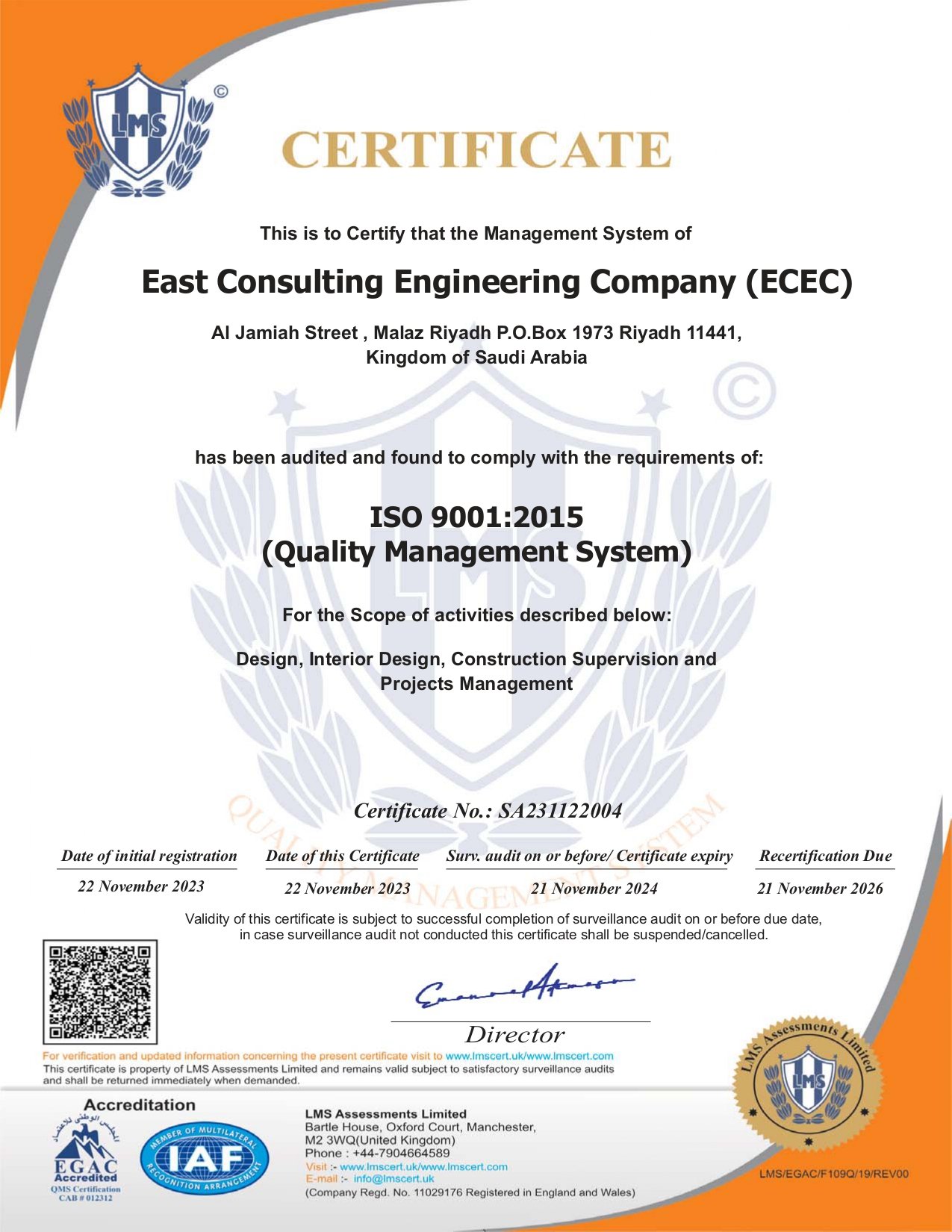
02. ISO 9001:2015
Quality Management Systems · International Organization for Standardization
Quality Management Systems · International Organization for Standardization
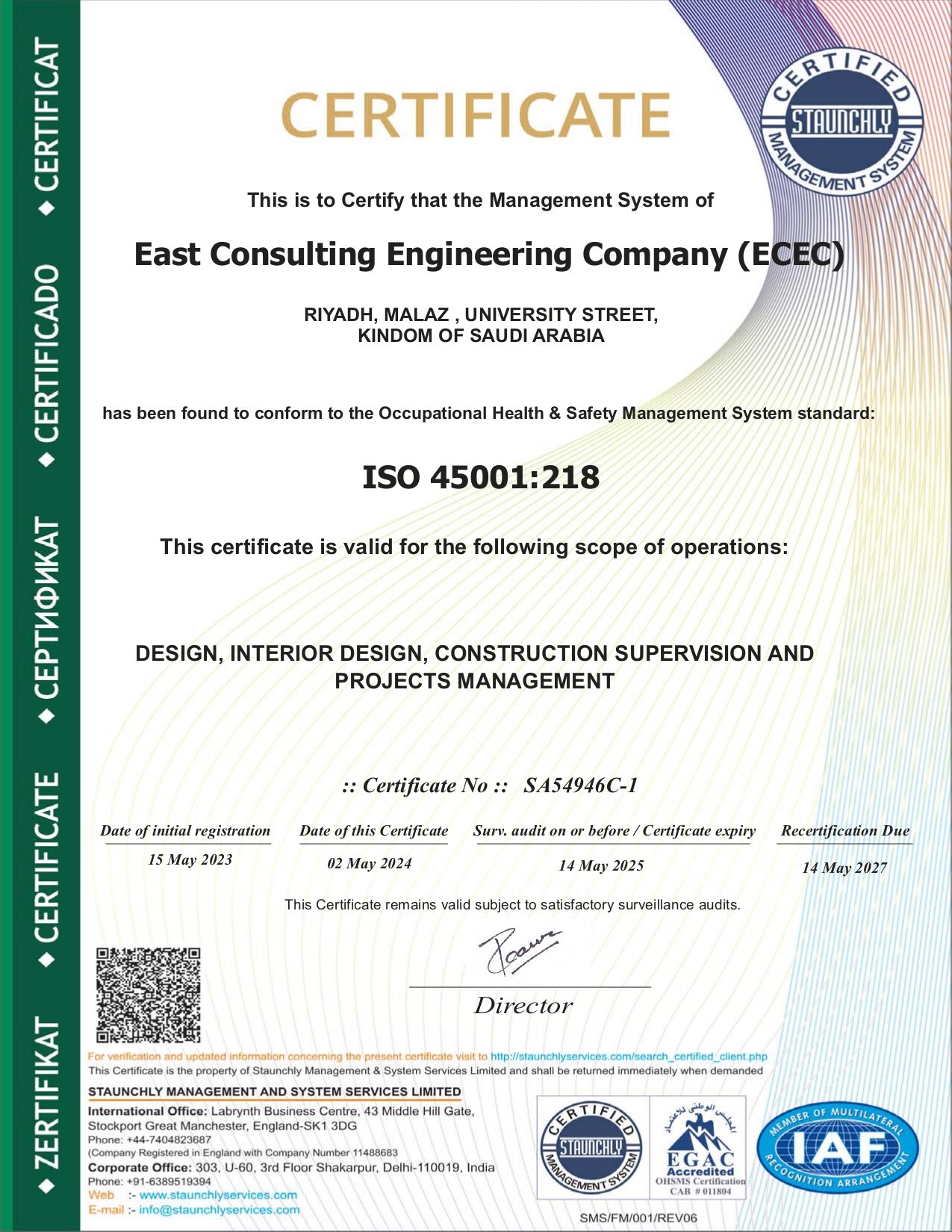
03. ISO 45001:2018
Quality Management Systems · International Organization for Standardization
Quality Management Systems · International Organization for Standardization
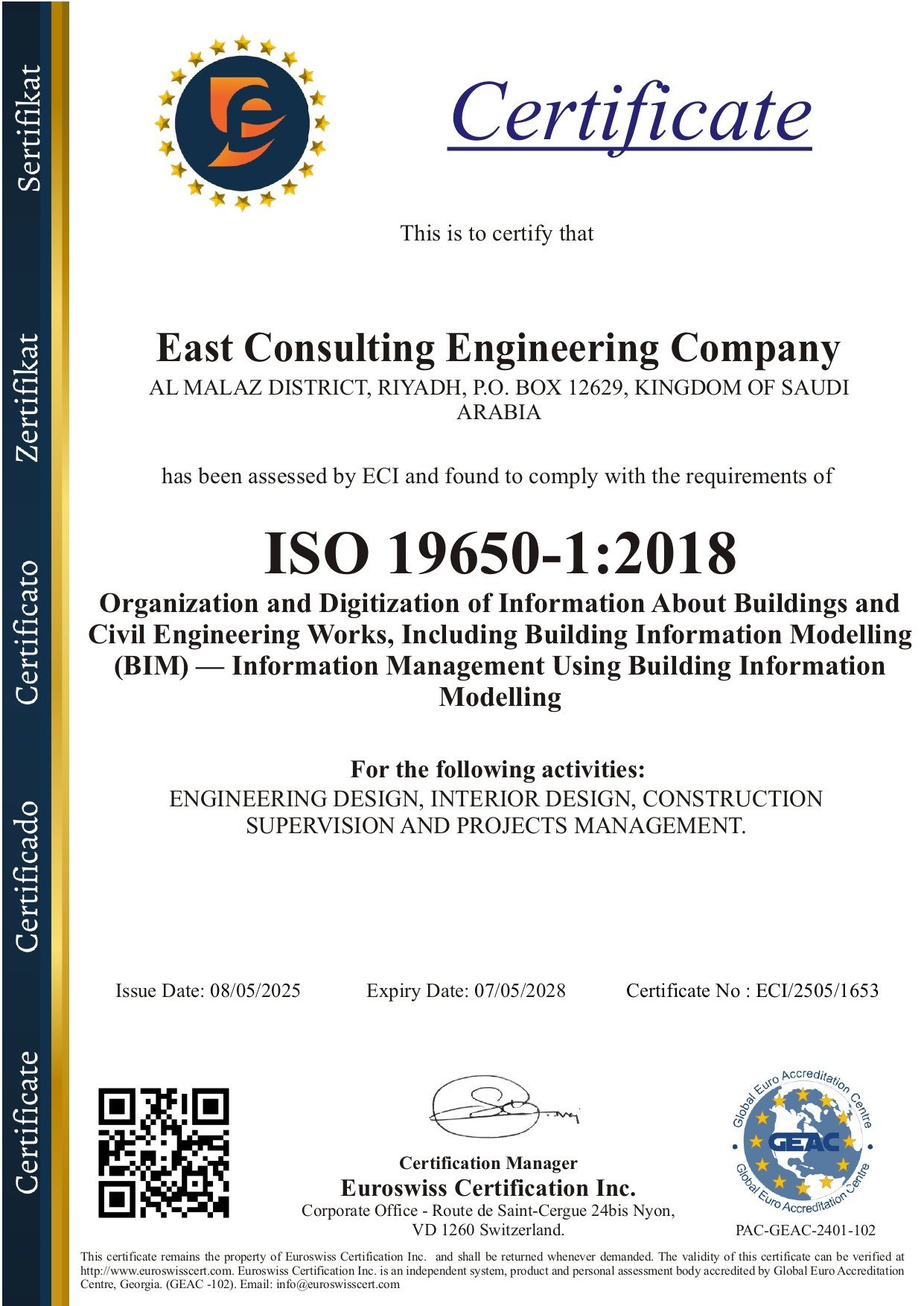
04. ISO19650:2018
Quality Management Systems · International Organization for Standardization
Quality Management Systems · International Organization for Standardization